
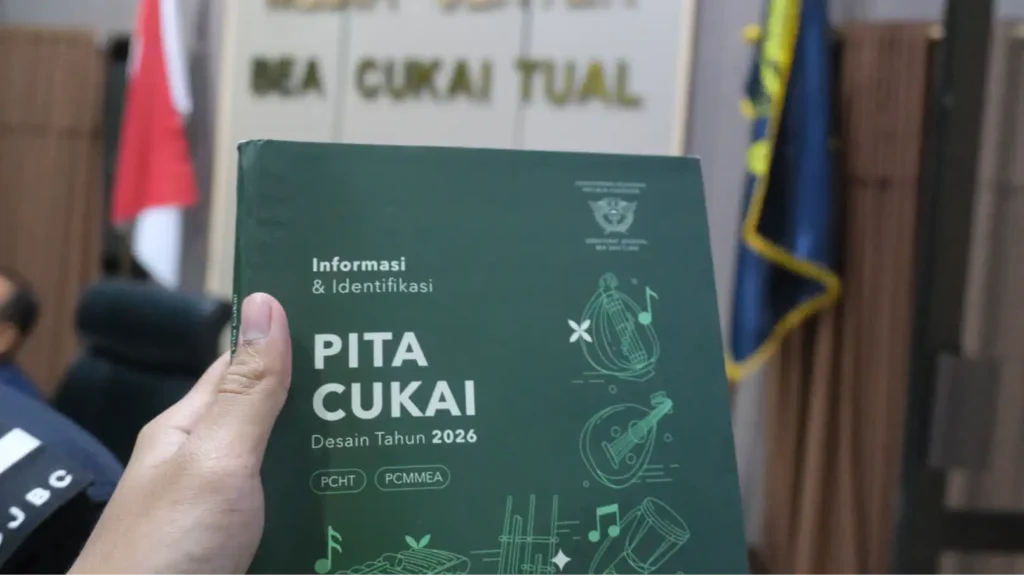
Businesses, importers, and manufacturers of Exciseable Goods (BKC) should take note of the updated excise stamp specifications introduced under Ministry of Finance Regulation No. 57 of 2026 (PMK 57/2026).
Enacted by Minister of Finance Purbaya Yudhi Sadewa on July 30, 2026, and effective as of August 10, 2026, this regulation amends the physical form, specifications, and design requirements for excise stamps. The updates aim to enhance oversight and safeguard excise stamps against counterfeiting and misuse.
PMK 57/2026 serves as an amendment to PMK No. 52/PMK.04/2020 on the Physical Form, Specifications, and Design of Excise Stamps. Crucially, the new regulation removes the security hologram requirement from excise stamp specifications.
Beyond these technical adjustments, businesses and importers must strictly comply with excise stamp application guidelines, as non-compliance carries severe administrative and criminal penalties.
What Is an Excise Stamp?
An excise stamp serves as proof of excise duty payment attached directly to the packaging of excisable goods. According to the Directorate General of Customs and Excise (DGCE/DJBC), excise stamps fulfill several vital functions:
- Proof of Payment: Acts as a security document certifying that excise duties have been fully paid.
- Regulatory Oversight: Serves as a monitoring mechanism to ensure compliance with applicable laws during product distribution.
- Quantitative Control: Functions as a tool for quantitative policy enforcement to regulate the volume of excisable goods in circulation.
- Product Authentication: Helps manufacturers and businesses verify product authenticity.
- Public Vigilance: Enables consumers and the public to monitor the legitimate distribution of excisable goods.
- Anti-Counterfeiting: Designed as a fraud-resistant proof of payment that is difficult to forge yet simple to authenticate.
Key Specification Changes Under PMK 57/2026
PMK 57/2026 fundamentally revises the physical specifications previously governed by PMK 52/2020. Article 2(3) of PMK 52/2020 originally mandated three physical security components: security paper, security holograms, and security printing.
Under PMK 57/2026, the security hologram requirement has been eliminated. Consequently, excise stamp specifications are now streamlined into two core elements:
- Security paper
- Security printing
This modification represents a major operational adjustment for manufacturers and importers of excisable goods under the updated framework.
Design Requirements
While physical specifications have been updated, PMK 57/2026 maintains strict design standards. Article 2(4) re-establishes five mandatory elements that must appear on every excise stamp:
- The Coat of Arms of the Republic of Indonesia (Garuda Pancasila)
- The official logo of the Directorate General of Customs and Excise
- The applicable excise tax rate
- The fiscal year indicator
- The retail selling price (HJE) and/or net volume/content quantity
As a result, the removal of the security hologram does not alter these five core design elements.
Proper Application Procedures
In addition to mastering the updated specifications and design rules, importers and manufacturers must adhere strictly to proper application procedures. Key requirements include:
- Appropriate Allocation: Information on the stamp must exactly match the product type, content volume, Retail Selling Price (HJE), excise rate, and/or Ethyl Alcohol (EA) strength shown on the package label.
- Authorized Ownership: Stamps must correspond directly to the specific rights granted to the registered manufacturer or importer.
- Physical Integrity: Stamps must be unused, intact, and undamaged prior to application.
- Single-Unit Rule: Exactly one stamp must be used per individual retail package.
- Proper Placement: Stamps must be affixed across the opening mechanism of sealed packaging.
- Tamper Evidence: Stamps must be designed to tear or destroy upon opening the package.
Strict adherence to these operational rules is essential, as incorrect usage or improper affixation can trigger major financial and legal consequences.
Penalties for Non-Compliance
Violations of excise stamp regulations carry steep administrative and criminal liabilities:
- Unpaid Duty Assessment: Any excise stamp affixed contrary to regulations will render the excise duty legally unpaid.
- Duty Shortfall Assessment: If incorrect stamp usage leads to an underpayment of excise duties, the manufacturer or importer remains legally obligated to pay the balance owed.
- Administrative Fines: Pursuant to Article 29 of Law No. 39 of 2007 on Excise (UU 39/2007), non-compliant affixation incurs administrative fines ranging from 2 to 10 times the total amount of excise duty due.
- Criminal Prosecution: Unlawful transactions—including offering, selling, transferring, buying, receiving, or using unauthorized excise stamps—are subject to severe criminal sanctions.
Under Article 58 of UU 39/2007, offenders face imprisonment ranging from 1 to 5 years, alongside substantial criminal fines.
Conclusion
The implementation of PMK 57/2026 marks a significant structural update to Indonesia’s excise administration. By removing the security hologram, the government has simplified physical stamp requirements into security paper and security printing, while maintaining the five mandatory visual design elements.
Manufacturers and importers must review their internal compliance and labeling processes immediately to avoid steep administrative fines and potential criminal liability.